


 Menu
Menu


Technology in hotel rooms: Why TVs could become obsolete and WiFi is king

The difficulties of keeping hotels technologically up to date was discussed by a round table of leaders debating research conducted by The Caterer in partnership with Ruckus Networks
Hotels used to lead the way with in-room technology, impressing guests with the latest trends in television and media in their rooms, but many have found that it’s no longer possible to keep up with the rate of change and stay profitable.
Guest attitudes have changed too, with many opting to watch films on their laptops or phones, which creates its own challenges, such as supplying a robust WiFi network vital for a satisfactory guest experience.
Informed by exclusive research conducted by The Caterer in partnership with Ruckus Networks, a group of hospitality technology specialists debated how hotels could strike the balance between delivering the infrastructure that would offer an experience expected by today’s guest and future-proofing their business against investments that would soon become obsolete or not provide the necessary return on investment.
The panel

From left
- Rob Flinter, regional general manager, Westmont Hospitality Group
- Steve Johnson, senior director of EMEA hospitality, Ruckus Networks
- Jane Pendlebury, chief executive, HOSPA
- Rachelle Peterson, founder and chief executive, Loqia Group
- Mark Read, IT director, Firmdale Hotels
- James Richmond, chief executive, Nevaya
- Darren Sweetland, chief financial officer, Soho House
- Steve Waldron, chief information officer/chief financial officer, Grange Hotels

Pace of technological change
Embracing technology continues to be a challenge for the hospitality industry for various reasons. Darren Sweetland, chief financial officer at Soho House said: “The challenge across the business is when you can’t see the return on investment because it’s too far away. We have seen a recent shift to technology that saves money, but again, that’s evolving so quickly that companies are unsure if they would soon need to upgrade [again]. The challenge is about making the wrong decision: do you buy now or do you hold back?”
“We have to accept that we can’t compete with what customers have at home”
Steve Waldron, chief information officer and chief financial officer at Grange Hotels, agreed that the speed of change is a challenge: “The pace of change in technology has accelerated and we have to accept that we can’t compete with what customers have at home. We have to get off that treadmill and instead select niche technology products that impress guests.”
TVs are indicative of the problem with in-room technology, according to Richmond, who said the average lifespan of a TV is seven to 10 years. However, he added that they can be kept up-to-date without having to resort to costly ‘rip and replace’ by instead importing streaming capabilities into devices.

WiFi is crucial
Thankfully, for hospitality, it has become significantly easier to adopt new technology by using the cloud, but that also means there is a strong reliance on robust WiFi. Mark Read, IT director at Firmdale Hotels, said: “It‘s the kingpin in the room – it matters more than the plumbing. We get more complaints about the WiFi going down than we would about having no water. The sentiment of [customer] reviews is down to the WiFi.”
Rachelle Peterson, founder and chief executive of Loqia Group, agreed: “Guests enter their rooms and log-on to WiFi within seconds,” she said. Against this backdrop Waldron suggested that hotels need to have the backbone in place for connectivity and suggested that the industry has benefited from advances in data compression that has enabled streaming into rooms. However, the threshold has been reached on the capabilities of the technology, and fibre will inevitably need to be installed into all guest rooms.
Data dilemma
One result of implementing these technologies is that hotels now have an abundance of rich data, which Read believed it should be better used: “We need to leverage the technology we have for new things,” he said. He cited the use of PCI-compliant tokenisation (where a guest’s financial information is converted into ‘tokens’) that would enable guests to be tracked via the payments they make around the hotel’s facilities to enable them to receive a more personal service.
Sweetland said that all too often hotels do little with the data they have, in contrast to major technology suppliers such as Apple and Google, which are moving into the hospitality sector. Likewise, online travel agents “intercept the data and do things with it. We should do a better job, but it comes with costs,” he added.
The art of revenue management
AI is already having an impact on the hospitality industry and within hotels this is being particularly keenly felt in the area of revenue management. Waldron said: “AI will nail it. We are already seeing the trend on the booking channels. That’s not to say AI will replace the chief revenue officer, but it will make them more agile.”
Rob Flinter, regional general manager at Westmont Hospitality Group, said that revenue managers using AI effectively can do their job in “half the time”, but that managers are also essential to the process because they are needed to interpret the data. Pendlebury was very much in agreement: “There is an art to revenue management. It’s not science.”
Read has found the use of AI at the front end of the industry increasingly impressive, especially now that it can interact naturally with customers. “You have to be realistic about how good it is now. Unless you’re in [the] luxury [end of the market], it will replace people,” he said.

Green focus
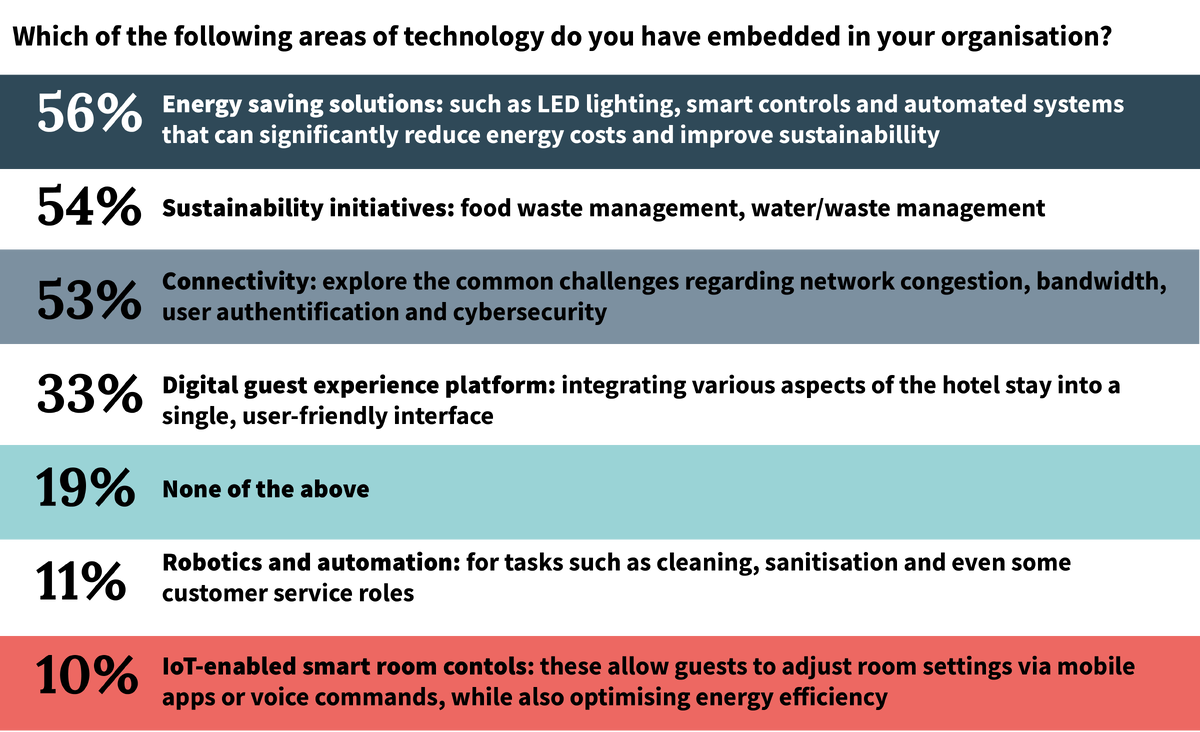
Technology that delivers energy savings is increasingly being implemented across the hospitality sector and it is an area that will receive greater focus as improving efficiency becomes more critical to a business.
“Guests expect it now – it’s front of mind. Whether it’s being able to see the water temperature on the taps in the kitchen or having five different recycling bins, guests expect it,” says Sweetland.
Steve Johnson, senior director of EMEA hospitality at Ruckus Networks, suggested there is an opportunity for hospitality to take a leadership position in energy-saving initiatives: “I wouldn’t check the [environmental] credentials of a hotel before making a booking, but my kids would.”
One advantage of AI-powered technology on a hotel’s tech stack is its ability to manage sustainability more efficiently. “You can simply press a button and turn the network into energy-efficient mode” he said. “Pre-AI this would have taken a lot of manpower, but now it’s just the press of a button.”

Legacy and integration
One of the ongoing major obstacles for the hospitality industry in adopting technology is the complexity of integrating the various solutions with existing technologies, which frequently involves legacy systems.
Flinter said that if a technology solution can be integrated from the start, rather than having to be retro-fitted into an existing infrastructure, it can make a dramatic difference. He cited the example of a major trial he undertook with robots to deliver items to guests’ rooms during the night shift.
“The problem was integrating them with the lift systems. Robots are able to easily go into new-build hotels [because integration is possible],” he explained. “There are lots of developments in technology within housekeeping. If you build a hotel now it would be very different,” said Flinter.

Standard offer
The hospitality industry is not unusual in being partial to a one-stop-shop approach when buying technology, according to Johnson, who said: “What’s required to broaden technology adoption is integrated solutions… the more consolidation that happens, the easier it becomes, but it also becomes more generic.”
Flinter also highlighted the fact that AI used by revenue management teams also risks of a lack of differentiation, because with everyone using universally accessible data that’s then analysed by AI technology, there is the potential for the likes of room rates to become very generic.
Which satellite service?
For Waldron, one of the major technology considerations for the forthcoming year is the delivery of media into guest rooms. There is always the ability for guests to simply use their own devices to access films and other content, but they are tending to still use hotel TVs. This mix of access has given hotels the ongoing challenge of whether the return on investment of continuing to deliver the likes of Sky and CNN into guests’ rooms stacks up.
This was also on the mind of Read, who suggested that usage analytics could help make decisions on what media comes into rooms. He said Apple and Google are making a play to drive technology into hotel rooms, but this requires the hotels to take their hardware and integrate into their eco-systems.
RUCKUS Networks
RUCKUS Networks delivers purpose-driven networks that offer the best possible performance for the unique needs of the hospitality industry.
Together with our network of trusted go-to-market partners, we empower hospitality brands to deliver a differentiated level of connectivity to their guests and employees, no matter what. Because when “good enough” networking just isn’t good enough, hospitality leaders turn to RUCKUS.
In the hospitality industry, guest experience is the only metric that matters. There’s a high bar to meet, but the right network can lay a solid foundation for exceptional experiences and improved brand loyalty. That’s why so many hospitality properties turn to RUCKUS for technologies that deliver exceptional guest connectivity experiences. A RUCKUS network delivers immediate and long-term ROI through a combination of revenue generation and operational cost reductions.
A RUCKUS Network delivers VIP experiences for every guest with:
- WiFi and switching connectivity
- IT and OT convergence
- IoT integration
- Analytics
- Safety, security and loss prevention









More from The Caterer

Most Popular




The Caterer People Summit 2026
 Thu May 14, 2026
 The Line, London
The Acorn Awards 2026
Sun Jun 7, 2026
The Cateys 2026
Tue Jul 7, 2026
Natural & Organic Food Show
Wed Sep 16, 2026ExCel London


The Caterer provides trusted hospitality news, analysis and trends for restaurants, hotels and catering professionals.

Jacobs Media is a company registered in England and Wales, company number 08713328. 3rd Floor, 52 Grosvenor Gardens, London SW1W 0AU.
© 2026 Jacobs Media
