



 Menu
Menu


Cyrus Todiwala’s moong daal samosas
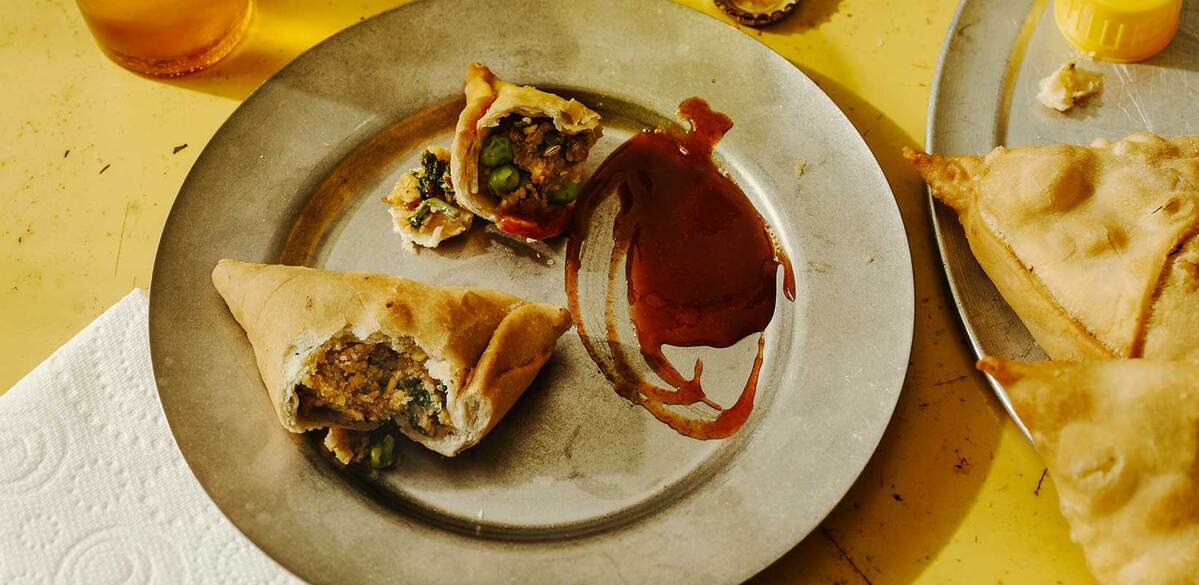
Samosas made with an unusual dry lentil filling and homemade pastry
In the city of Allahabad you’ll find some deliciously unique samosas. Instead of being stuffed with a ‘wet’ filling – and by wet I mean something that has been cooked in a pan and softened, and could be eaten on its own – a moong daal samosa is filled with ground lentil powder or soaked and ground lentils that are cooked until dry. Here, I’ve added my own twist by adding the green peas and green chillies found in classic samosas into this daal version.
Makes 8 or 10
For the pastry
- 250g plain flour, plus extra for dusting
- 1tsp fine sea salt
- 2tbs ghee or neutral oil
For the filling
- 3tbs neutral oil, plus extra for deep frying
- 1tsp cumin seeds, lightly crushed
- ¼tsp asafoetida
- 2tsp ground coriander
- 2tbs fennel seeds, lightly crushed
- 4tsp Kashmiri chilli powder
- 2tsp garam masala
- 2tsp amchoor (mango powder) or lime powder
- 600g split yellow mung beans, soaked in water for 2-3 hours, then blitzed in a blender to a coarse purée
- 2 long green chillies, finely chopped
- 1 handful of spinach, chopped
- 4tbs peas, defrosted if frozen
- 1tbs finely chopped fresh coriander
Start by making the pastry. Sift the flour with the salt into a bowl. Add the ghee or oil and gently rub it in until it is well mixed, then add cold water, a little at a time, until a firm yet smooth dough forms. Cover and set it aside, while you make the filling.
Heat the three tablespoons of oil in a wok or frying pan over a low-medium heat. Add the cumin seeds and then the asafoetida. As soon as the cumin changes colour, add the remaining spices, soaked and blended split yellow mung beans and green chillies. Mix together and fry well, making sure you regularly scrape the bottom of the pan with a flat spatula to prevent sticking.
When the mixture naturally stops sticking to the pan, stir in the spinach, peas and coriander and remove from the heat. Taste to season, and transfer the contents to a bowl to cool.
Meanwhile, tip the rested dough onto a lightly floured work surface. Gently knead the dough into a smooth ball and then roll it out into a cylinder shape roughly 2.5cm-3cm thick. Cut into four or five equal slices. Roll each slice into a flat disc roughly 2mm thick. Cut each disc in half, to create eight or 10 semi circles.
Place a small bowl of water to one side – this will help you seal the samosas. Take one semi-circle and bring the cut edges together to form a cone. Using your fingers dipped in water, brush along one of the edges and gently press together with your thumb and forefinger to seal, creating an open pocket for the filling.
Spoon some of the cooled filling into the open samosa pocket – it should be three-quarters full – then apply some more water with your finger to the remaining open edge and press together again to seal and create a puffed-up triangle. Repeat until all of the samosas are stuffed and sealed.
In a large, deep pan, over a medium heat, heat enough neutral oil to submerge the samosas. (The oil can be reused for cooking, so long as you cool and strain it well and store it in a sterilised jar or bottle.) The oil is hot enough when you gently lower a samosa into the oil and after a few seconds it bobs up to the surface. Take care not to overheat the oil. Fry the samosas in batches, if required.
Cook until the samosas are browned on all sides. Carefully scoop out using a spider strainer or tongs and drain on kitchen towel (paper towel).
If you’re not planning to serve immediately, fry for half the time so the pastry is cooked but not coloured. Drain as above, leave to cool completely and then chill in the fridge and either fry again or bake in a preheated oven at 130ºC fan/150ºC for 15-20 minutes or until golden and crisp. The samosas can also be cooked and reheated in an air fryer, if you have one.
Taken from Modern Indian: Small Plates, Big Flavours, Fabulous Feasts by Cyrus Todiwala (£22, White Lion Publishing)
Related content






More from The Caterer
Most Popular





The Caterer People Summit 2026
 Thu May 14, 2026
 The Line, London
The Acorn Awards 2026
Sun Jun 7, 2026
The Cateys 2026
Tue Jul 7, 2026
Natural & Organic Food Show
Wed Sep 16, 2026ExCel London


The Caterer provides trusted hospitality news, analysis and trends for restaurants, hotels and catering professionals.

Jacobs Media is a company registered in England and Wales, company number 08713328. 3rd Floor, 52 Grosvenor Gardens, London SW1W 0AU.
© 2026 Jacobs Media
